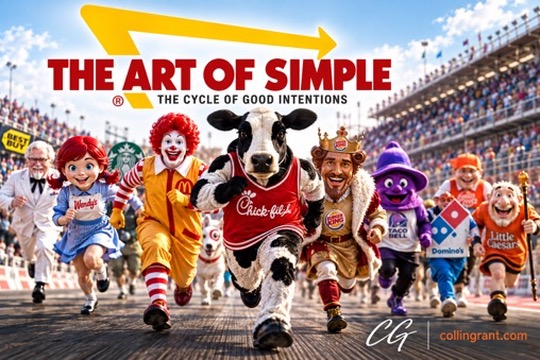
I didn’t set out to write an article about fast food.
But it turns out QSR is a pretty great place to watch the phenomenon I really want to talk about play out. We all understand the product. We know what fresh tastes like. We know when the fries aren’t hot. We notice when the restaurant isn’t clean. We know when service is good. And most of us have repeated these transactions enough times, over enough years, to notice when things change.
That makes fast food a remarkably useful laboratory.
So while I’m going to talk about Wendy’s, In-N-Out, Chick-fil-A and maybe a cup of coffee, don’t get too comfortable. This isn’t really about them. You can replace every logo in this article with one from almost any industry. Maybe even the one on the business card you’re carrying right now. In fact, I’ll give you a chance to do exactly that a little later.
Because this is about what happens when businesses drift from their promises and complicate something customers already understood. When they optimize away pieces of the experience that originally earned preference, mistake tolerance for approval, and eventually discover that the brilliant turnaround strategy is to return to what earned the customer in the first place.
Welcome to The Art of Simple.
We Knew This
I worked at Wendy’s as a kid, and Wendy’s taught me a lot. Freshness mattered. Cleanliness mattered. Standards mattered. Hot fries mattered. The Frosty was magic. The chicken sandwich was an actual chicken breast cooked in actual fat in a pressure fryer. There was a right way to do things.
Wendy’s also taught me that efficiency and quality weren’t enemies. A hamburger patty that had been held too long to serve as a hamburger didn’t necessarily become waste. It became chili. That’s smart. They found additional margin without making my hamburger worse.
Optimize behind the experience, not out of the experience.
Somewhere along the way, Wendy’s, like a lot of businesses, learned another version of optimization. Change the pickle. Change the bun. Reduce staffing. Raise the price.
Businesses don’t make decisions in a vacuum. Owners want a return. Employees want more. Suppliers want more. Costs rise. Customers resist higher prices. Everyone wants a bigger taste of the transaction, and management has to protect margin at scale. Most bad decisions have a rational parent.
There doesn’t have to be a mustache-twirling villain in the room. A series of individually defensible decisions can eventually produce a collectively indefensible experience.
The Dangerous Part Is That It Works
Change the pickle. What happens? Probably nothing. Customers keep coming and you saved three cents. The spreadsheet says it worked. So you change something else, and still nothing.
This is where businesses begin confusing tolerance with preference. The absence of objection is not the presence of preference.
Customers tolerate small compromises because you’ve already given them reasons to choose you. Great experiences created preference. Preference created trust. Trust put your logo on The List. Success gives you something to spend, and success creates the tolerance that can eventually destroy the success.
The three-cent savings appears immediately. The trust withdrawal doesn’t. Your supplier sends an invoice. Your employees tell you what labor costs. Your landlord tells you what rent costs. The customer doesn’t send an invoice when you make the experience a little worse. The margin improvement shows up this quarter. The trust withdrawal may not show up for five years.
They keep coming until they don’t. And they probably won’t tell you which pickle did it. One day they simply realize, I don’t really like that place anymore. Your logo quietly falls off The List.
They spent your loyalty a nickel at a time.
Simple Became Disruptive
Now look at In-N-Out: focused menu, fresh food, clean restaurants, kind people, high standards and consistency. Chick-fil-A is much the same: fresh food, clean restaurants, kind people, good service, high standards and consistency.
Neither company invented any of those things. The chicken sandwich argument notwithstanding.
They became remarkable by being remarkably good at things customers already valued. And somehow, in mature industries filled with enormous competitors, Simple became disruptive.
People will voluntarily sit in drive-thru lines wrapped around buildings like somebody is stapling $20 bills to every bag. The line is evidence. People want to do business where business is being done, and the line creates social proof, FOMO and momentum. But customers are also willing to wait because Simple doesn’t necessarily mean fast. I understand the proposition. I know what I’m going to get. I trust the outcome. Choosing is easy.
After enough consistent experiences, fresh food, clean restaurants, kind people and high standards no longer exceed my expectations. They become my expectations. That’s where the responsibility shifts to the business.
The promise isn’t to keep exceeding the expectation. It’s to keep protecting what created it. A real brand promise isn’t copy for a website. It’s a standard the business uses to police itself, especially as it grows.
Growth should happen on your principles, not at their expense.
The Math Is Pretty Simple Too
I talk a lot about another way of looking at businesses:
People + Product + Process = Profitability
Profitability sits on the right side of the equal sign for a reason. When it works, you want more of what’s on the right, so the temptation is to start subtracting from the left: fewer people, cheaper product, less service, compressed process.
And for a while, it can work. That’s the trap. The savings are immediate. The spreadsheet says it worked. Meanwhile, preference, trust and experience can be moving in the opposite direction.
Subtracting on the left side always ends with a smaller number on the right.
The delay is what fools us. You can temporarily improve the answer by subtracting from the equation. You can’t change the math.
Simple Isn’t Easy
None of this is an argument against efficiency. Reduce waste. Improve systems. Use technology. Train better. Just know where the efficiency belongs.
Keep the complexity on your side of the counter.
Years ago, I shared a story about a Chick-fil-A airport location whose payment system went down. They could have transferred their problem directly to the customers standing in front of them: Sorry, payment system is down.
Instead, they gave people their food while they worked through the problem. Their IT problem remained their problem. The customer’s experience stayed simple: I ordered food. You gave me food. Have a nice flight.
Simple for the customer doesn’t mean simple for the company. It can take enormous sophistication behind the scenes to make the experience feel effortless in front of it. Simple requires maintenance.
The Art isn’t making it simple. The Art is keeping it simple.
The Cycle of Good Intentions
This is the phenomenon and underlying pattern I’ve identified across businesses and industries: The Cycle of Good Intentions.
I call it that because good intentions are usually where the cycle starts—and, if we’re humble enough, where it can start again.
This is where the pieces start to look more familiar—and we might even see our own brand or business in the story, caught up somewhere in the cycle. Most businesses don’t wake up one morning and decide to abandon what made them successful. They drift there through a series of decisions that made sense at the time.
Build something customers value. It works, so you grow: more customers, more markets, more products, maybe acquire competitors. Growth brings complexity, and complexity puts pressure on the economics, so you optimize. Cut costs. Raise prices. Consolidate. Automate. Change suppliers. Find efficiencies. Most of those decisions can be completely rational.
Then comes the hinge: you begin testing customer tolerance.
Maybe deliberately. Usually accidentally. Make a change and watch the numbers. Nothing happened. Make another. Still nothing. What the spreadsheet can’t tell you is that the business may now be spending what the earlier stages earned: trust, preference, brand value, momentum and its place on The List.
Eventually the accumulated compromises become visible. Standards drift. Preference weakens. Performance follows. Then the business reaches for promotionality to stimulate the transactions preference used to create naturally.
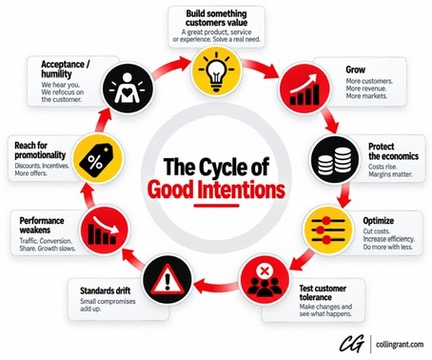
The logos change. The cycle is remarkably consistent.
Take a look around the cycle and see if there are signs from your own business? What milestones have you already passed? What might be waiting ahead? How will you disrupt it?
We Can Always Put It on Sale
Promotions aren’t inherently bad. They can create trial, reward loyalty, launch something new or create urgency. Promotionality is different.
Promotions exchange margin, brand value and trust for quicker liquidity.
Repeated often enough, though, it teaches the customer something. If the $10 thing keeps becoming an $8 thing, eventually I learn that it’s an $8 thing. Then I wait.
A purchase isn’t always proof of preference. Sometimes you bought the purchase. And if you continually have to buy the customer’s transaction, you haven’t rebuilt the relationship. You’ve rented the transaction.
Promotionality can create a cash transfusion. It can’t cure the disease that made you need one.
Eventually, the business runs out of things to optimize and transactions to buy. What comes next requires something different: acceptance and humility.
We hear you. We’re refocusing on the customer. We’re getting back to what made us great.
And if we’re humble enough, good intentions begin the cycle again.
Deliver the Original Promise
Wendy’s leadership recently acknowledged that cost savings had received too much attention while ingredient quality suffered and promotionality became too important. The turnaround? Make the food better. Run the restaurants better. Improve the stores. Improve the marketing. Make ordering easier. Get the value equation right.
None of that sound particularly revolutionary. That’s the point. Think about how complicated an organization has to become before make the food better and run the restaurants better qualifies as a turnaround strategy.
Wendy’s doesn’t need to invent the future of hamburgers. It needs to get better at being Wendy’s.
And Wendy’s isn’t alone. Starbucks’ turnaround strategy is literally called Back to Starbucks. Invest in the people. Improve operations. Restore the customer experience. Get back to what earned the customer in the first place.
Funny how the turnaround plan always looks suspiciously like the original plan.
Growth teaches companies what they can add. Trouble reminds them what they should never have subtracted.
Which brings me back to the simplest question in all of this: What did the customer actually agree to?
Click to Agree
So maybe the best place to end this is with the customer. What if the customer got to write the agreement?
Not another 47-page EULA nobody reads before scrolling to the bottom and clicking Agree. A simple one.
THE CUSTOMER AGREEMENT
By accepting my money, you agree to:
- Make something good.
- Maintain your standards.
- Make choosing you easy.
- Treat me well.
- Charge me fairly.
- Don’t make your efficiency my compromise.
- And when something is already great, have the discipline to leave it the hell alone.
☑ Click to Agree
Now try something. Let your customers write the EULA. Ask them what you should never compromise, what you make unnecessarily difficult, what you’ve changed that they wish you’d change back, and what they’re tolerating that they don’t actually prefer.
Then give it to your employees and ask the people closest to the customer whether your company actually honors it. Finally, put it in front of leadership.
Because the uncomfortable question isn’t whether the customer will click Agree. They do that every time they give you another transaction.
Would you click Agree to the agreement you’re currently asking your customers to accept?
Turn it up!