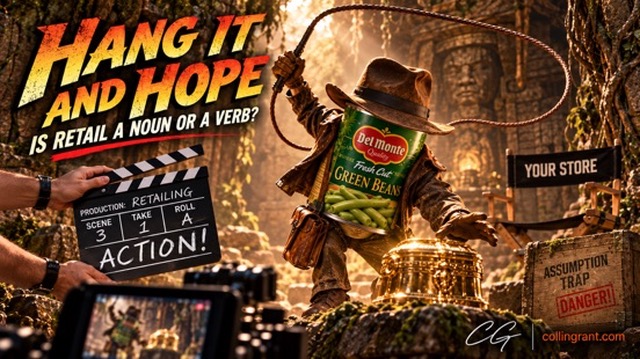
In the guitar business, there’s a pretty straightforward way to display something a dealer would like to sell.
Hang it on the wall.
A guitar arrives. Someone opens the box, inspects it, tunes it, puts a price tag on it and finds an empty hook. There it is. Available for sale.
It’s at this moment we reach an interesting fork in the road—and many of us don’t notice.
Retail can be a noun or a verb.
As a noun, retail is a place, a channel, an assortment. We bought the guitar. We put it on display. We made it available to the customer.
But retail is also a verb. And a verb implies action.
So, what happens next?
Well, that’s the whole thesis.
Some of us default to the noun.
We wait.
Days turn into months.
Occasionally, guitars have birthdays in the store.
And sometimes waiting works. But often it doesn't.
Hang It and Hope might work just fine in a grocery store. Put a can of green beans on the shelf and eventually somebody will probably rescue it.
Green beans aren’t particularly emotional. Music is. Customers are.
Maybe part of the problem begins when we treat everything we sell solely as a commodity. A SKU. A price point. A turn rate. Something to acquire, display and eventually move.
Those things matter. But somewhere on the other side of all that inventory is a person. And people need reasons to notice, care, imagine, prefer and ultimately choose.
Without that connection, time simply keeps moving. That new guitar isn’t quite so new anymore. The strings get tired. It collects some dust. Employees walk past it enough times that it becomes part of the scenery. Eventually somebody looks at how long it’s been there and decides it’s time for a markdown.
Then maybe another.
What started as an opportunity eventually becomes an inventory problem.
This is Hang It and Hope.
The Assumption Trap
There’s a reason we get here, and I don’t think it’s because people don’t care.
Retailers have finite resources. Every buying decision ties up money, occupies space and carries some degree of risk. Get burned enough times and you grow some scabs. You learn to flinch. Historical data starts to matter because experience has taught you that it should.
So we wait and see. Sometimes that’s exactly the right decision. The problem is when wait and see stops being a decision and becomes the default.
Buyers try to pick winners and losers every day. We all do it. Blue doesn’t sell. That price point is too high. My customers don’t want that. This model always works here. Experience becomes a hypothesis, the hypothesis becomes an assumption, and eventually the assumption starts shaping the conditions that appear to prove it true.
If I believe blue doesn’t sell, I buy very little blue. Customers have very little opportunity to choose blue. My sales report shows very few blue guitars sold.
See? Blue doesn’t sell.
That’s a self-fulfilling assortment.
The same thing happens when we simply replace the empty hook. That guitar sold, so I’ll buy another one. It feels like a safe decision because now I have a data point. But the customer who bought it probably isn’t coming back tomorrow to buy the exact same guitar again.
We didn’t bottle lightning. We gained a data point.
And so did the customer.
Every buying decision teaches us something about our customers, but every assortment decision teaches them something about us. They’re learning our store at the same time we’re learning them. They learn whether we have variety, whether there’s something new to discover, whether we tend to have what they like and whether checking with us is worth the effort.
Choice becomes part of the experience, and eventually part of the expectation. Baskin-Robbins didn’t become known for one really dependable flavor. Thirty-one flavors taught us something about what to expect before we ever walked through the door.
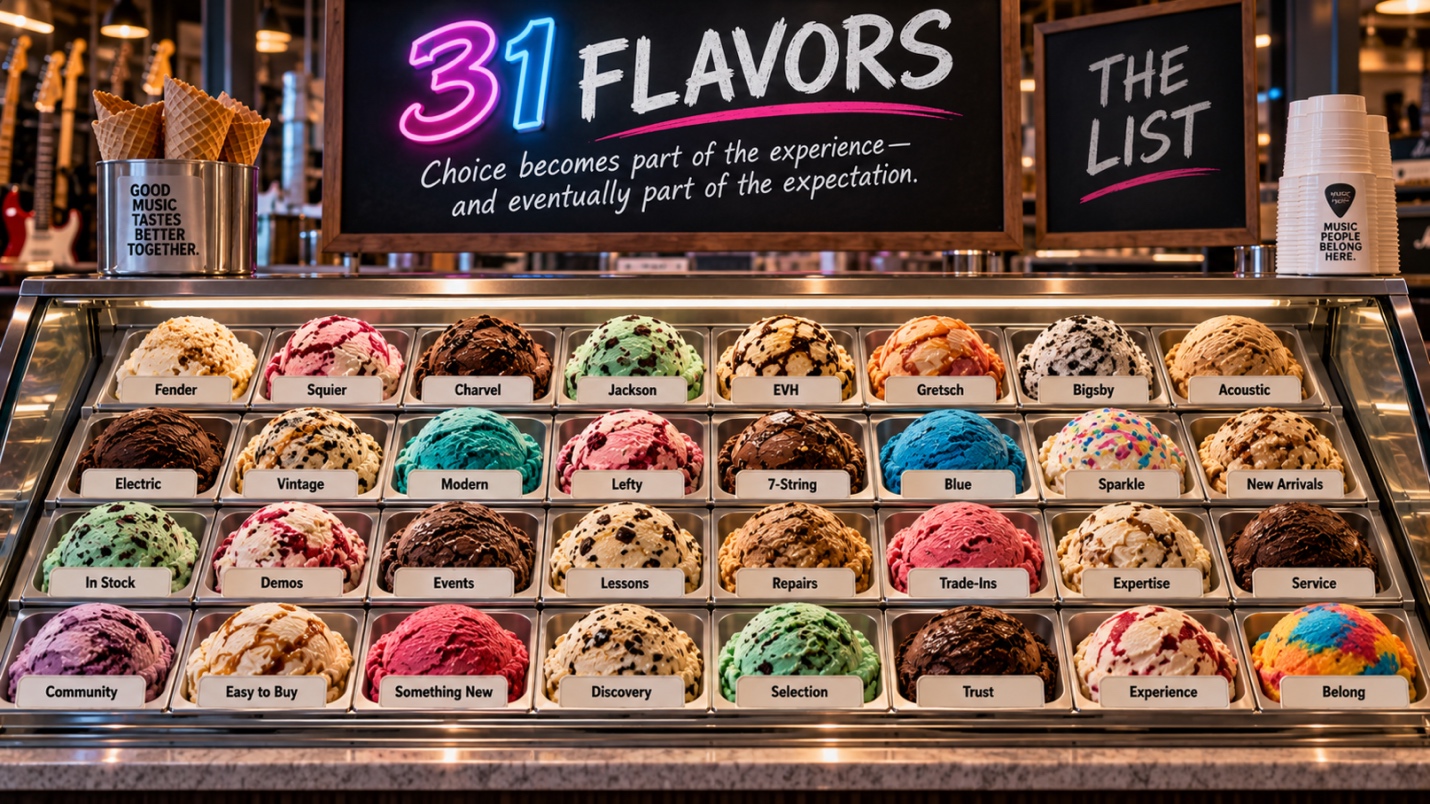
What flavors do you offer?
I wrote about this from the customer’s perspective in The List. They prioritize. They learn which businesses are worth checking first, which ones tend to have what they’re looking for, which ones surprise them and which ones gradually move farther down the List until they eventually fall off.
That’s perception in action.
Successful retailers find ways to intersect with prospective buyers and customers at those moments when interest, curiosity and intent are already in motion. Sometimes they create that energy themselves. Sometimes a brand, a product, an artist, a friend or a cultural moment creates it for them.
The opportunity is in the intersection.
When it doesn’t happen, there usually isn’t an alarm. The customer keeps scrolling. The retailer keeps going about the day. The guitar stays on the wall. The energy quietly passes between them, and neither may ever know how close they came to a great experience.
But the customer’s energy doesn’t necessarily disappear. It keeps moving. In that near miss, we may have simply set up a competitor with the opportunity to intersect with that customer instead, create the experience we missed and earn their way onto the List.
That’s one of the problems with inaction. We can measure the guitar that didn’t sell. It’s much harder to measure the customer we never met.
We meticulously measure the cost of what didn’t sell. We’re much worse at measuring the cost of what we never tried.
Something to Talk About
Retailers wear a lot of hats. Buyer. Accountant. HR. Operations. IT. Customer service. Merchandiser. Salesperson. Brand ambassador for any number of brands. A day can be completely full without ever feeling like there were enough hours in it.
Marketing may be one of the hats that doesn’t fit quite as comfortably. Or maybe it’s the one we keep putting farther down our own "to do's" because everything else feels more immediate.
And there may be an assumption hiding in there too: I thought the brand did all that for me.
In many ways, it does. Brands spend enormous amounts of time and money creating products, building awareness, telling stories and giving customers reasons to want them.
But there’s a handoff.
The brand creates interest in the product. The retailer creates interest in the store and the experience. Why should the customer buy it here? Why should they visit, follow, call, click, ask, come back—or put us on their List?
That’s where our own marketing toolbox matters. And that toolbox keeps getting bigger. AI is the obvious example right now. Some retailers are already using it to research, create, analyze, communicate and move ideas into action. Others are still standing back, trying to decide what they think about it.
That feels familiar.
The tool itself is a noun. What we do with it is the verb.
But at some point, retailers have to ask themselves: Why did I buy the inventory? Why did I take on the brand?
Presumably, because they wanted to sell it. They believe in it, and they believe their customers will too.
That’s where activity and action can quietly become two different things. I can select a product, place the order, receive it, price it, merchandise it, put it into inventory and be genuinely busy through the entire process.
But did I do anything that gave someone a reason to care?
Having something available and creating interest in it are not the same thing.
Those who work around me have probably heard me say, “Give ’em something to talk about.” I’ve had that one on loan from Bonnie Raitt for years.
I don’t mean post more on social media. I mean find the energy.
A new product might provide it. A great story might provide it. An artist can create it. So can a salesperson, a local musician, an event, a customer or something happening in the culture. Sometimes the brand creates the energy and we can amplify it. Sometimes it’s already moving around us, and we can grab onto it.
And sometimes we have to create it ourselves.
Because while we wait, the customer doesn’t.
They’re at home scrolling through the category. They’re watching demos, reading comments, talking to friends, seeing advertisements, visiting stores and learning from other customers. Interest is being created and buying cycles are beginning whether we’re participating in them or not.
Somebody is giving them something to talk about.
If our strategy is to let somebody else create the product, create the energy, spark the interest and move the customer through most of that journey—and then hope that at exactly the right moment they happen to walk through our door and choose us—we’ve really just built a much larger version of Hang It and Hope.
The guitar isn’t the only thing sitting there waiting.
We are too.
The Part We Can Control
People want to be loyal. I know I do. There’s comfort in having a place, a person or a brand you trust. It makes decisions easier, and it feels good to be part of something rather than just a visitor.
But you still have to give me a reason.
Loyalty isn’t the customer’s contribution to the relationship. It’s one of the outcomes of the experience we create. Yesterday’s loyalty doesn’t automatically become tomorrow’s transaction.
Showrooming is real. Online competition is real. Direct-to-consumer is real. Price pressure is real. Traffic changes. Customer behavior changes. There will always be something happening around retail that we don’t control.
Owning part of an outcome isn’t the same thing as accepting all of the blame. It simply helps us identify the part where we can act.
And I don’t think retail is dying.
Retail is learning.
It always has been. Customers change. Technology changes. The tools change. Best practices evolve with them.
But learning requires participation.
That may be the real danger in Hang It and Hope. It doesn’t just leave the guitar hanging on the wall. It limits what we get to learn.
We learn from the things we try. From the customer we engage. From the assortment we change. From the story we tell. From the idea that works—and sometimes even more from the one that doesn’t.
Data matters. Experience matters. Assumptions have their place. But eventually, something has to create the next data point.
Action does that.
And maybe that’s the simplest answer to the question I started with.
Retail can be a noun. We need the stores, the channels, the brands, the products and the inventory. They give us something to retail.
But the opportunity lives in the verb.
It’s the intersection. The conversation. The experience. The reason to care. The reason to choose. The thing that moves us from what we already know toward whatever we’re going to learn next.
If retail is who we are, then I recommend that it also be what we do.
Turn it up!