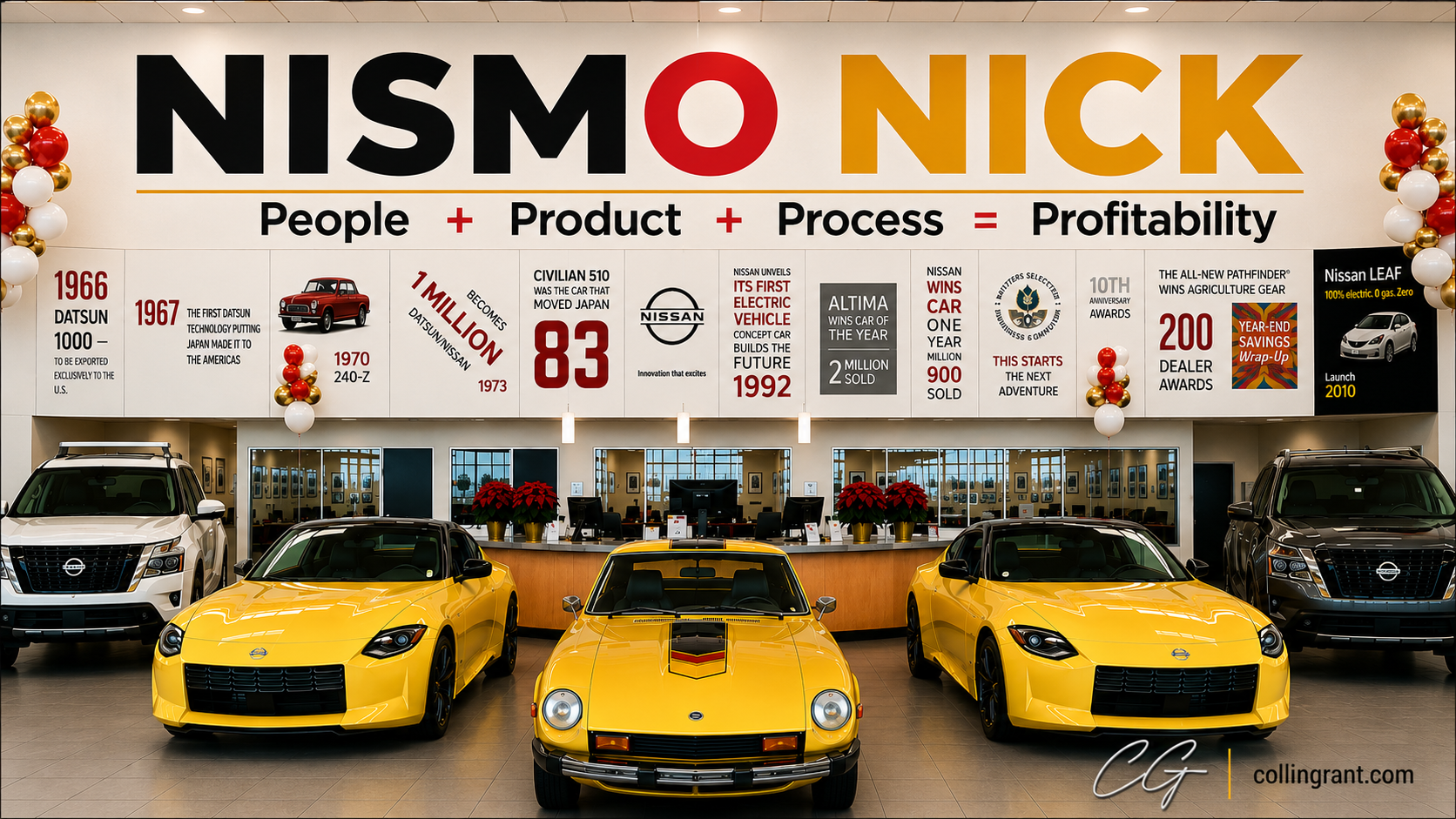
The Nissan Z is a historically significant Japanese sports car with roots going back to the first Datsun 240Z in 1970. Since childhood, I have always loved the lines. To young me, it looked like a life-size Matchbox car. That relationship escalated into ownership in 2003, and Nissan earned it back then.
I was in Miami for business meetings when Nissan essentially surrounded my hotel and most of Ocean Blvd. with a full marketing activation supporting the newly launched 350Z. Full disclosure, I had this car in my sights long before I came down for those meetings and I was firmly planted in the “Want It” stage of the buying cycle. I was young in my career and buying sports cars didn’t math then, so “Want It” was where I was appropriately stuck.
But when I walked out of the hotel to a surprise pop-up concert from Stone Temple Pilots, with Zs in every color sitting behind velvet ropes right out front and a giant Batman-style Z emblem projected onto the side of my hotel, Nissan marketing essentially started shoving me right through the buying cycle. If those weren’t already signs from above, at the end of the night I found myself outside with the DeLeo brothers, STP’s guitarist and bassist. They came over to me to bum a cigarette.
I remember handing over the pack and saying, “Tell Nissan I’ll take it. Their marketing is incredible.” They had no clue what I meant until I explained it, and they loved it.
And I did just that. I went home firmly settled into my newly found “Gotta Have It” part of the cycle and ordered a new 350Z in Brickyard.
Marketing for the win.
I’m still a Z owner. I bought a first year 2009 370Z, which I still have and keep as a garage queen. I belong to several Z enthusiast groups online, follow the model closely in the market, and follow the much larger aftermarket built around performance, restoration and customization. It has a large, almost cult-like following.
Twenty-three years after Nissan convinced me to buy one, something interesting happened.
I put a Nissan salesman on my vacation itinerary.
I was going to be in Scottsdale on PTO, and I wanted to drive over and meet Nick Scherr. Not because I needed a car.
I wanted to meet him.
If you spend any time in the Z community, you probably know him as Nismo Nick — NISMO being short for Nissan Motorsports, the fun side of the brand.
Nick has built a reputation around a single product that extends far beyond his dealership. I knew who he was before I’d ever spoken to him. His customers knew him. Z owners knew him. Enthusiast groups knew him.
When I got there, Nick had recently learned that he had surpassed 250 new Zs sold. For perspective, authorized Z dealers average only a single-digit fraction of that annually. Nick was keeping roughly 20 Zs in rotating inventory and moving one or two a day. Even while I was hanging around with him, cars were moving out onto car carriers to meet their new owners.
But the volume isn’t what interested me most.
The Product Wasn’t the Problem
To understand what Nick has done, you have to understand what happened around the launch of the new Z.
Coming out of COVID, scarcity and overpayment had become almost normalized across categories — cars, houses, watches and plenty of other goods. In the auto industry, market adjustments became commonplace. Dealers learned that when something desirable was difficult to get, somebody might be willing to pay considerably more than sticker to get it.
The new Z arrived in 2023 with enormous anticipation and a passionate enthusiast base already waiting for it. Many dealers reached for the obvious lever: price.
Market adjustments piled onto MSRP. Short term, it worked. But enthusiasts talk. Screenshots travel, prices travel, and dealer reputations travel right along with them.
Over time, some of the people most predisposed to love the Z became frustrated with the experience of trying to buy one. Demand softened as buyers pushed back on price. Dealers became less enthusiastic about stocking them. Some rarely kept one at all.
The Product wasn’t the problem. The Process around buying it had become one.
Nick couldn’t control Nissan’s allocation strategy, dictate what another dealer charged, or repair an entire dealer network. What he could do was take ownership of the problem sitting directly in front of him.
Like a log blocking a river, sometimes you can’t move the whole problem at once. But you can kick the part in front of you a little farther downstream. That’s what Nick did.
He got his GM onboard, invested deeply in the product, pulled in as much inventory as possible, and became active and accessible within the enthusiast community. He knew the cars, loved the cars, answered questions and helped customers feel confident about buying them.
And he sold them at sticker.
The fact that Nick sold at sticker matters, but maybe not for the obvious reason. He didn’t have to discount to create demand, which is usually one of the first tools retailers reach for when business gets difficult. Cut the price. Run the promotion. Give something away.
But Nick didn’t overcharge either. He simply sold the product for what it was supposed to cost and created value around it through knowledge, accessibility, trust and the experience of buying from him.
He didn’t have to discount. He didn’t have to overcharge.
And customers noticed.
Taking Ownership Created Owners
“Nismo Nick” became the guy who loves Nissan and sells Zs at sticker. Over time, that rebuilt the “know, trust, like” dynamic in a very real way. Customers started finding him, the enthusiast community started talking about him, and then more customers found him.
Eventually Nick didn’t have to pursue nearly as much business because the business was pursuing Nick. Customers came to him not only for Zs, but for aftermarket parts, advice and his own builds. Trust was being shared organically inside a community that already shared a passion for the product.
Other dealers started sending Z inventory his way because Nick had something they didn’t: customers who wanted to buy them.
Inventory follows trust.
Trust created demand. Demand attracted inventory and selection, which attracted even more customers.
Today Nick has more than 60 of the very scarce 2027 Zs and one of the largest selections of new Zs in the country.
Still no markup.
Nick took ownership of a problem he didn’t create so more people could become owners of a Product he believed in.
It’s the Little Things
While I was working through this story, Nick made a post that couldn’t have been timed much better: a thank-you letter.
In a world increasingly moving toward AI, automation, self-checkout and contactless transactions, Nick posted a simple letter thanking a customer for buying his Z, welcoming him into the Z family and reminding him that Nick was there if he needed help with the car, NISMO parts or accessories.
His caption was equally simple: “It’s the little things that make the difference.”
Exactly, Nick.
The sale isn’t the end of Nick’s Process. It’s the beginning of ownership.
And that made me think about how differently I arrived at Nick’s dealership than I arrived at my first Z.
Twenty-Three Years Apart
In 2003, the brand created the experience. Nissan surrounded me with Product. Zs behind velvet ropes, the giant Z projected onto the hotel, Stone Temple Pilots playing outside. They took me from “Want It” to “Gotta Have It,” and I bought the car.
Twenty-three years later, much of that enthusiasm had been squandered at the point of sale. Market adjustments and a frustrating buying experience had created distance between the Z and the very enthusiasts who should have been its biggest advocates.
Nick stepped into that gap.
One salesperson took ownership of rebuilding an experience he hadn't broken. Nobody marketed Nick to me. He didn't prospect me. I wasn't responding to a promotion, and I wasn't even shopping for a car. His reputation traveled through a community I was already part of until I put meeting him on my vacation itinerary.
Think about the shift in weight there. In 2003, an enormous brand activation helped turn me into a Z owner. In 2026, one salesperson had created enough gravity around the Product to make me go meet the guy.
The giant marketing machine can create desire for a Product, but the People and Process representing it ultimately have to deliver on that promise. They can amplify everything the brand spent millions creating or squander it.
Nick was rebuilding it.
The 4Ps
And that’s when something familiar showed up again.
I’ve spent a lot of my career thinking about retail through a simple equation:
People + Product + Process = Profitability
Standing there with Nick, all four were staring me in the face.
The Product was obvious: the Z, with more than half a century of heritage and an incredibly passionate community around it. The People part was standing in front of me: someone who genuinely believed in that Product, understood it, participated in its culture and had become trusted by the people buying it.
His Process was equally clear: get the inventory, price it fairly, be accessible, educate, help, follow up and remain part of the ownership experience after delivery.
And the Profitability side of the equation followed: more than 250 Zs sold, cars moving every day, parts and accessories, referrals, inventory flowing toward him and more than 60 2027 models in inventory.
There’s something conspicuously absent from my version of the 4Ps:
Price.
That’s intentional.
When People, Product and Process are working together, Price doesn’t have to do all the work.
Nick didn’t have to discount his way into demand, and he didn’t have to exploit scarcity to create margin.
He built value somewhere else.
What’s Your Log?
We spend a lot of time talking about soft demand, price sensitivity, competition, the economy, the internet, AI, customers waiting for deals and customers being harder to reach. Some or all of those things may be true.
But describing the river doesn't move the log.
Nick saw a problem developing around a Product he believed in and a community he cared about. He didn't create it and couldn't fix all of it. He simply took ownership of the part he could and kept kicking the log downstream.
Eventually customers started coming to him. Then inventory started coming to him. Then the manufacturer started listening.
Maybe the question isn't what Nissan should have done, what the other dealers should have done, or what customers should have done.
Maybe it's much simpler:
What's the log sitting directly in front of you, and what are you doing to move it?
Turn it up!