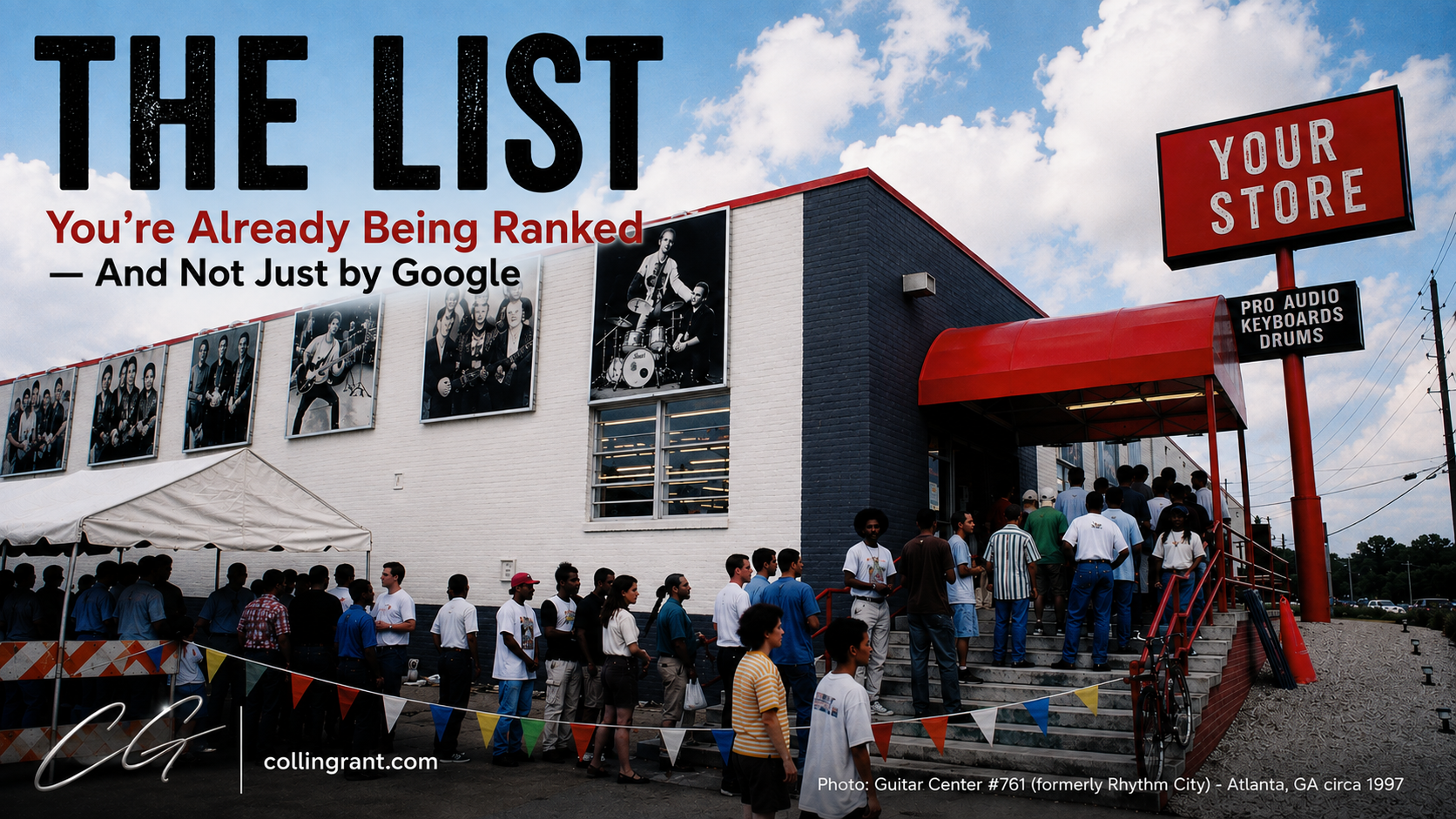
People make lists. Consciously and subconsciously, we use them every day to prioritize where we spend our time, money, attention and interest.
Imagine you get a couple of hours to yourself on Saturday. What are you going to do with them? Hit the driving range? Go to the gun range? Catch a movie? Stay home with the PlayStation? Go wander through a guitar store?
You just made a list.
Let’s say the guitar store wins. Great, which one?
There’s another list.
How do you choose?
Maybe one store has the biggest selection. Another always has cool used gear. Maybe there’s a salesperson you enjoy talking to, or a store where the inventory seems to change every time you visit. Maybe you remember finding something cool there last time, so there’s a little anticipation about what might be there today. Everybody likes the chance to stumble upon something cool!
Then there’s the store where nothing ever seems to change. Same guitars, same hooks, same experience. You’ve been there enough times that you feel like you already know what’s inside before you leave the house.
You probably don’t consciously say, “I’m moving that store from number two to number four.”
You just don’t go.
That is The List, and that’s what needs our focus.
The customer has ranked you whether either of you consciously realizes it. Maybe you’re first. Maybe you’re third. Maybe you used to be first. Maybe you’ve fallen off entirely.
The tricky thing is that the customer doesn’t share that List with you. Nobody calls the store on Friday afternoon and says, “Just wanted to give you a heads-up. You used to be the first guitar store I visited when I had some free time, but lately you’ve slipped to third.”
They just go somewhere else first. Often that somewhere is online, where the inventory is always changing. Bet they’ve favorited a few shops there too.
Another list.
That makes The List incredibly easy for a business to miss. We can see traffic decline, sales soften and inventory age, but we can’t see the customer sitting at home deciding we aren’t worth the drive this Saturday.
Then we start reaching for explanations. The economy, competition, pricing, the internet, the market or whatever else happens to be nearby. Some of those things may be real, but there’s still a mirror sitting in front of us with the best solution we have looking back at us.
Where are we on their List, and what have we done to earn that position?
We aren’t just competing against the guitar store down the street. We’re competing against everything else fighting for the same customer’s finite time, money and interest. Before we ever get an opportunity to win the transaction, we must win the visit.
That means the experience matters even when nobody buys anything.
Give Them a Reason to Come Back
The customer has been telling us this forever. We just have a strange habit of interpreting the answer as rejection.
“Can I help you?”
“No thanks, I’m just browsing.”
“Can I help you find something?”
“Nope, just looking.”
There it is. They’re browsing. They’re looking.
We browse online all the time without knowing exactly what we want. Sometimes discovery is the whole point. A guitar player wants to bump into the next thing he has to have, to find himself entering a buying cycle he wasn’t in five minutes earlier.
We all want the opportunity to fall in love with something, and we want to repeat that experience over and over throughout our lives.
That realization changed how I engaged customers and eventually how I taught other people to engage them. One of my favorite greetings became, “Do you want to see something cool today?”
Of course they do. That’s why they came in.
Maybe it’s a weird used pedal that came in yesterday, a guitar everybody on staff has been talking about or simply whatever caught your attention this week. Maybe they hate it. Fine. They’ll probably tell you why, and now you’re having a conversation about what they actually like.
You may not earn the sale today, but you can absolutely earn the next visit.
That next visit is The List.
Inaction Has Weight
The dangerous thing about falling down The List is that you don’t necessarily have to do something wrong. Sometimes you simply stop giving people reasons to choose you.
I can’t tell you how many times I’ve watched a regular customer suddenly notice a guitar that had been hanging in a store forever and say, “Oh man, when did THIS come in?”
Six months ago. Two years ago. Maybe five.
It happens because we stop seeing familiar things. Think about the pictures hanging in the hallway of your own house. You know they’re there, but when was the last time you actually looked at them?
A store can become the same way. Nothing catastrophic happened. Nobody offended the customer. There wasn’t some disastrous transaction that sent him running to a competitor. The store simply stopped creating enough curiosity to justify another visit.
That matters because inaction has weight. Every unchanged experience, disengaged interaction and predictable visit can quietly push your name farther down the List.
He just chooses something else next Saturday.
Energy Creates Energy
The opposite is also true. Stores that feel alive create their own gravity.
Larry Thomas, former co-CEO of Guitar Center, used to say something that has stuck with me for decades:
“People want to do business where business is being done.”
Walk past two restaurants and you immediately understand what he meant. One has people waiting outside and suddenly you want to know what they’re eating. The restaurant next door is empty and, fairly or unfairly, the food already has a mental strike against it before anybody serves you a bite.
Nobody had to explain either restaurant to you. You processed the signals and adjusted your List.
We do this everywhere. Activity creates interest, interest creates engagement and engagement creates more activity. Energy creates energy.
I’ve watched this play out for more than 30 years along my career path. Some stores needed to be resuscitated, and others just needed to be put into overdrive, but the phenomenon was remarkably consistent. When a store developed momentum, people felt it. When a store lost its energy, people felt that too.
They may never have articulated it.
They just adjusted their List.
Where Are You on Their List?
Stores changed, customers changed, technology changed and the competition for our attention exploded over those 30 years, but the behavior underneath it never really did.
The difficult part is that there isn’t a report for The List. Google can tell you where you rank in search and your sales report can tell you what happened after the customer arrived, but neither can tell you how many people thought about coming and chose something else.
That’s where the mirror matters.
When results aren’t where we expect them to be, external pressures are easy to find and many of them are real. What’s harder is asking whether we’ve become less interesting, less engaging or simply less worthy of someone’s limited time than we used to be.
The customer owns The List, but we own what we do to influence our place on it.
So, where are you? And better yet, what are actions are you taking?