
A new product often begins its life surrounded by enthusiasm.
The people who developed it may have spent months or years considering the customer, solving problems, fighting for features and bringing an idea into the world. They understand why it exists, what makes it different and what it can do.
Then the product begins moving through the organization.
Product management passes it to marketing. Marketing builds the story and passes it to sales. Sales carries understanding and belief into the field. The brand passes it to its dealers or distribution partners. Dealers pass it to their frontline teams. Eventually, someone introduces it to a customer.
Every launch has a chain of custody.
At each handoff, enthusiasm can be preserved, amplified, diluted, distorted or lost entirely. Information may arrive without context. Assets may arrive without belief. Products may arrive without anyone understanding why they matter.
But enthusiasm is not a sealed package that must simply be delivered intact. Every person in the chain changes it. We receive energy, create energy of our own, add context and decide what reaches the next person.
By the time the product reaches the customer, is the person at the end of the chain as enthusiastic about it as the person who started it?
Is the chain of custody intact?
The distance between those two points is the enthusiasm gap.
Like Evel Knievel preparing to cross the Snake River Canyon, we are about to discover the gap is real—and it’s wider than we think.
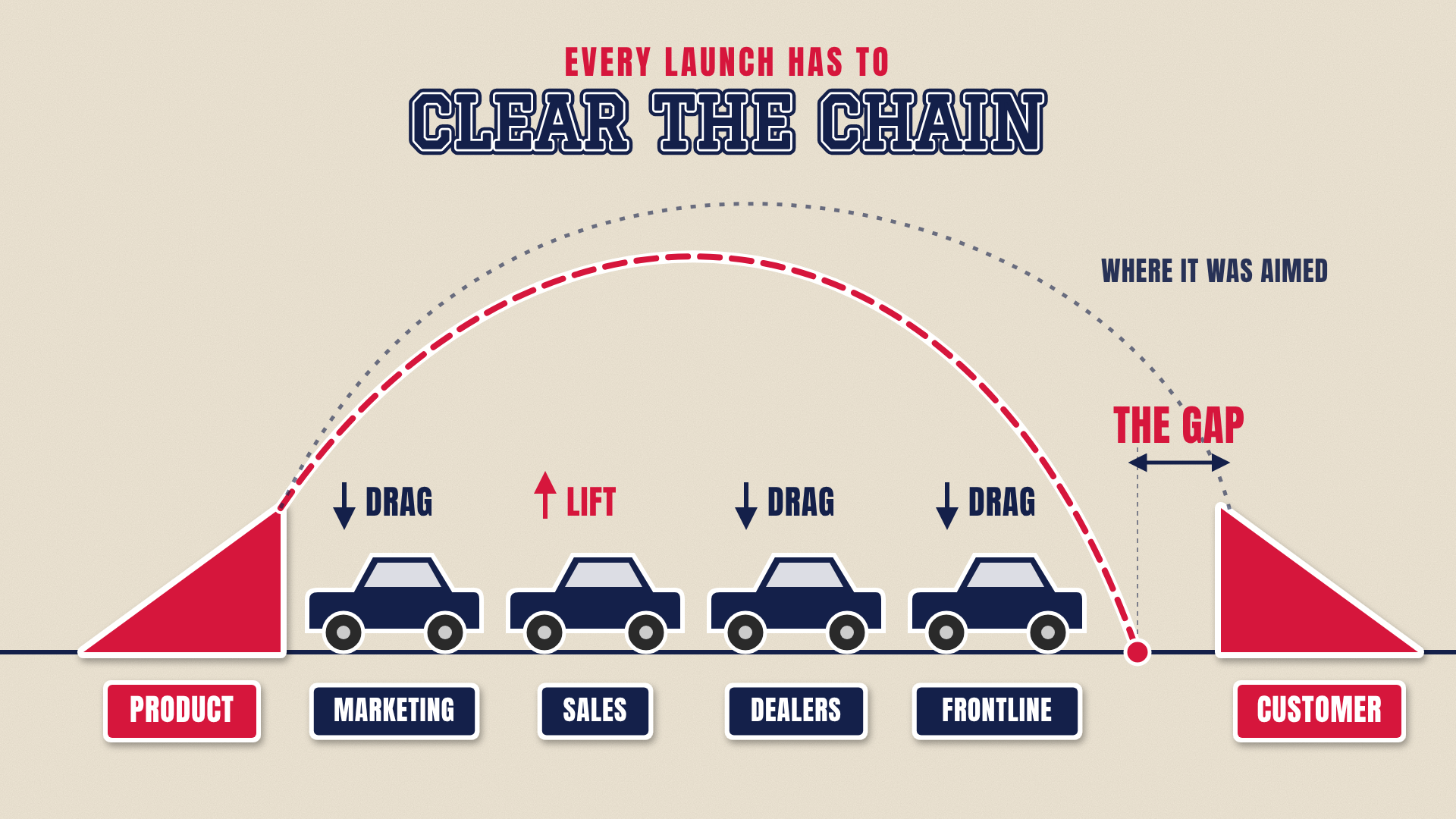
Tracing the Chain
The best launches happen when every part of the system is aligned. Product creates something worth caring about. Marketing gives it a story. Sales carries understanding and belief into the field. Dealers translate it into local action. Frontline teams create an experience customers can see, hear, touch and feel.
When those parts move together, enthusiasm travels.
When they don’t, the breakdown can occur at any number of stress points. The product or price may miss the market. Inventory may arrive late. Marketing may create attention before the field is prepared. Sales may communicate information without transferring meaning. A retailer may place the purchase order without creating any activity around the launch.
Sometimes several things are true at once.
That is why the most useful postmortems require brave leaders. Honest answers may be unpopular. They may challenge the accepted explanation, reveal assumptions that did not hold or show that several small breakdowns combined to create the result.
A postmortem should not become an exercise in assigning blame or protecting individual departments. Its purpose is to create a shared understanding of what happened.
Where did enthusiasm begin to weaken? Was it an isolated handoff or a common stress point? Did people receive only information, or did they understand why it mattered? Did the pattern appear everywhere or only in certain locations? Where results were stronger, what remained intact?
The useful questions are not only, “Where did it break?”
What did we receive? What did we add? What did we pass forward?
A one-time breakdown may be circumstantial. A repeated breakdown reveals a pattern. A pattern we understand gives us something we can improve together.
Sometimes our own part of the process will be among the things we discover.
Results Are Local
A launch may be measured nationally, but it is experienced one market, one store, one salesperson and one customer at a time.
Two stores operating in the same industry—and sometimes in the same market—can describe completely different realities. One says customers have disappeared, the market is dead and the business is enduring its worst season. Another, facing many of the same economic conditions, is having one of its best.
Markets, customers, inventory, capital and timing vary. So does motion. Some businesses are waiting for energy to arrive. Others are contacting customers, making content, demonstrating products, holding events, changing displays, training employees and trying new things.
Activity cannot overcome every market condition or excuse the wrong product, price, timing or message. It does tell us that “the market” is not experienced identically everywhere.
A launch does not produce one result. It produces hundreds or thousands of local results that eventually roll up into one number. That variance is not noise to average away. It may be evidence.
Readers of Hang It and Hope: Is Retail a Noun or a Verb? may recognize this behavior and perhaps our old friend Del Monte Jones.

Consider a retailer who places a purchase order for a major launch and treats the order itself as participation. There is no team meeting, customer outreach, demonstration, local content, event or meaningful presentation. The product arrives carrying all the energy created upstream and quietly becomes one more item in inventory.
“I know how these things go,” the retailer may think. “Vendors jump up and down with excitement, I bring in the product, and only a few sell. I can skip that spend, ride out the initial wave of enthusiasm and the tide goes back out.”
That’s the Assumption Trap returning to the scene. The ending has already been written, so every burst of energy is met with cold water.
That is the enthusiasm gap forming in real time.
The retailer treats enthusiasm as something to endure rather than something to receive, build upon and pass forward. That belief reduces the effort, reduced effort creates little visibility, and the weak response is then used to validate the original prediction.
The retailer did not merely observe the result. Their behavior helped shape it.
We are often quick to treat results as proof of what customers wanted and slower to examine the experience we gave them before they decided.
Beyond the Launch
The same examination can be applied far beyond a product launch.
A product manager may spend two years building something the sales team discovers through a slide deck. A factory employee may make one component of something extraordinary without ever seeing the finished product or understanding the life it affects. A new employee may arrive curious and full of ideas, then slowly learn which questions irritate people and how quickly “we’ve always done it this way” ends a conversation.
Eventually, that employee stops offering ideas. Leadership calls the resulting behavior disengagement without considering how thoroughly the organization trained them to disengage.
Ideas have a chain of custody. Culture has one. Customer promises have one. Trust, loyalty, curiosity and belief all move through human systems.
Enthusiasm can also begin anywhere inside those systems. Someone in marketing may see an opportunity that product management missed. A salesperson may find the story that makes the product matter. A factory employee may reconnect others to the pride in what they build. A retailer may create the local experience that brings the entire launch to life.
Every point in the chain can become a new source of energy.
Did the People Survive the Journey?
Those mechanical gaps deserve further examination, but I’ll leave you and your team to decide which ones you solve and which ones you ignore. Either choice will eventually show up in the result.
I want to dig into the part none of us can delegate: our individual role in the chain.
Each of us is a bridge between what we receive and what the next person experiences. We are also emotionally charged animals, bringing pressure, curiosity, confidence, frustration, hope and the accumulated weight of everything that happened before the handoff.

Before asking what anyone else might have done differently, I want to put my own hand up.
I have contributed to enthusiasm gaps. I have carried the wrong energy into the next conversation. I have allowed frustration to follow me into places where it did not belong.
I have missed opportunities to listen, encourage, acknowledge or carry someone else’s enthusiasm forward.
I own my portion.
I offer that we all take a deeper look inside ourselves—not to accept responsibility for every broken system around us, but to understand what happens to enthusiasm when it reaches our hands.
We spend a great deal of time asking whether people carried the company’s enthusiasm forward. We spend far less time asking what happened to theirs.
People are not pipes through which enthusiasm travels untouched. Every person in the chain absorbs the experience of carrying it. They receive pressure, rejection, incomplete communication, dismissed ideas, broken promises and the accumulated weight of previous interactions.
Before someone can share enthusiasm, they have to have some left.
I’ve always taught this through a simple metaphor: everyone carries a bag of rocks over their shoulder. Every rejection, difficult customer, mistake, disappointment, pressure or bad experience adds another rock. If you leave one customer’s home without emptying the bag, you carry that weight into the next. The next customer has no idea what happened before you arrived, but they experience its weight anyway.
So does the next coworker, and eventually, so does your family.
Learn the lesson. Leave the rock. Refresh and reset.
Sometimes experience produces wisdom. Sometimes it just produces weight. And sometimes we have to stop and empty the bag. We cannot ask people to carry enthusiasm indefinitely without acknowledging everything they are being asked to carry alongside it.
Every disappointment does not need to follow us into the next meeting. Every rejection does not belong in the next customer’s home. Every frustration from work does not deserve a seat at our family’s dinner table. And every difficult moment at home should not automatically be handed to the first person we encounter the next morning.
The enthusiasm gap does not clock in with us. It hears the alarm, carpools to work with us and sits down for dinner with our families. We even take it back to bed with us.
Then the alarm rings and we do it again.
Someone at home begins telling us about something that excites them. Do we look up and ask another question, or do we tune out, change the channel and wait for them to finish?
Do we still see potential in the job, business, relationship or life we already have? Or are we waiting for a new role, new product, new opportunity or future version of ourselves to make everything feel interesting again?
Sometimes we complain that nothing excites us while repeatedly stepping over every invitation to become engaged.
What Happens When It Reaches Us?
Some enthusiasm gaps are created by systems. Others form through repetition, disappointment, exhaustion or the accumulated weight people carry between interactions.
We may not have created every gap we encounter. Once we recognize one, however, we can examine what happens to the energy when it reaches us.
Do we receive it with curiosity? Do we add something of our own? Do we share it and pass it forward? Or are we carrying enough weight that we need to stop and empty the bag before the next handoff?
None of that requires becoming a walking billboard, an advertisement or some slick salesperson performing excitement on command. Enthusiasm is not volume, hype or forced positivity. It can be expressed quietly through attention, curiosity, belief, effort and follow-through.
When someone hands us something they care about, we should know whether we are carrying that energy forward or allowing it to disappear.
That requires a mirror.
When was the last time you were genuinely excited about something within your existing role? Do people still bring you their ideas and enthusiasm, or have they learned not to?
Has the gum in your day-to-day lost its flavor?
Then ask yourself: Are you waiting for inspiration, or are you trying to create it?
Recognizing an enthusiasm gap in our business, our role or our life means we are still aware enough to examine it. If we cannot find one anywhere, we may have been living inside it long enough that it now feels normal.
Trace the chain. Understand where the energy weakened. Learn what the experience has to teach you. Own the portion that rests in your hands.
Then ask yourself:
What did I receive? What did I create? What did I share? What did I pass forward?
Turn It Up!